Blood Products

Today was a recovery day after my last heavy duty chemo treatment. Although the treatment finished up at about 2am, the whole day was pretty much a wipe out, feeling very flat and very tired.

Visitors included family plus special visit from Granny and Pa all the way from Cootamundra. The main thought for today is the importance of keeping the blood products flowing through the system.

I’ve been a blood donor for more than 35 years and most recently committed to donating plasma on a monthly basis. Unfortunately moving forward I will not be eligible to donate any form of blood product. If you haven’t before, I would strongly encourage you to investigate the altruistic and life saving function of donating blood through the Red Cross Blood Bank.

To date I have probably received six bags of platelets and eight bags of red blood cells. Each time I look closely at the donation date and the use by date. I am very grateful to the anonymous donors who have donated this blood.

With a low platelet count, a blood nose can be life threatening as there is no way to stop the bleeding without platelets to come to the rescue.


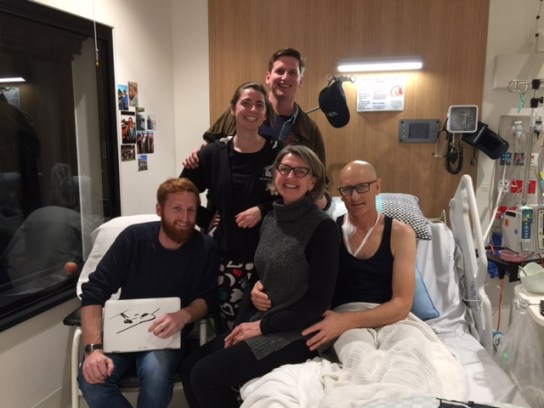
Jodie Coles has been a bit nervous to donate blood for a long time but today she bit the bullet. Good on you Jodie!


logo_fb_wide

 Day 10 – Food, Physio & Family

After a pretty good night (about 5 hrs broken sleep in between multiple blood tests, observations, toilet steps etc etc) the day started well.

Best shown by pictures:


  1. Managed to convince the Physio team to put a warning notice on the dangerous gym equipment!
  2. Finally got a Zimmer Frame
  3. Claire’s lovely Moroccan meatballs
  4. Pills glorious pills!
  5. Minestrone – homestyle sure beats hospital any day!

I have learnt a few interesting things with this Chemo business – they give you a massive cocktail of drugs. 2 major Chemo Drugs (as explained previously in HIDAC + 3) but there are the wide range of “Antis” – we have been writing this down each day and now have the “Anti-Board” which lists the anti-ulcers, anti nausea, antiviral etc.

At last count there were 5 different pills to take in any one day and up to 7 different IV Drugs – although this vary day by day.  And on top of that there are up to 9 different “on demand” drugs such as cough medicine, and Allopuranol (for uric acid removal).

So on a not so good day you might be putting 21 different drugs through your body and of course the more volumous ones lead to bloating and a large fluid increase (still seeing up to 3-4 kgs extra in a day!)

But guess what the best drug so far I’ve found to lower temps and reduce pain is Panadol!   4 x per day and it keeps you sane!


  1. Dougall managed to find some old and new family snaps to liven up the room. The whiteboards collect the daily medical information (blood counts, procedures for the day, new drugs added to the cocktail etc etc).  The Clock is an essential found by Claire – silent ticker!
  2. I’ve finally made old age – Zimmer frame and nappy!
  3. The nasty ugly ones are mine
  4. Lots of napping in between drugs and drugs
  5. And one benefit is the return to childhood of lemonade and other sweat treats – think jelly, custard, ice cream etc etc.


I can’t thank my darling wife enough for being (literally) by my side during the process. She’s been keeping one eye on me and the other on the medical staff, making sure everything runs as smoothly as possible.


This funny looking machine on is a platelet agitator which has been storing one of the many strange bags of liquid I’ve been putting through my body.

Platelets

Platelets are small blood cells important for the normal process of blood clotting. They act by clumping together to stop bleeding and bruising. They’re continually produced in the bone marrow and are completely replaced in the body every 8-10 days.
A healthy platelet count is between 150 – 400 (thousand cells / microlitre of blood). My platelet count today was 15.
Donate platelets are stored in an agitator like the one above to keep them continually moving, so their exposure to oxygen and carbon dioxide is constant enough to keep them activated. Donated platelets have a shelf life of only 5 days.


Having such a low platelet count means I’m constantly in danger of bleeding or bruising excessively from even the most minor injury. Had the first nosebleed today but thankfully it didn’t last too long.

The final prognosis from the Physio was “you’ve over done it” and it will take 3-4 days to get back to normal.  No major damage just a bloody sore calf muscle.

If you have a nice pic of yourself and me/Jan I’d love to add it to my Glory wall so email it on to me or Jan.
Day 9 – “Rest Day”

  • Terrible night with a busy ward full of emergencies, buzzers going off at all hours and busy staff
  • 2-3 hours sleep max.
  • Calf was extremely sore
  • Cannot walk on it/ put any weight on it (so I am now hobbling around)
  • Emergency note on my door saying “likely to fall”
  • Finished Chemo at 2am
  • Started platelets and Red Blood Cells at 8am
  • Ultrasound for damaged calf at some stage this afternoon
  • Discussed ‘lumbar puncture’ with Jo. Set for the next two days, ouch!
  • Another lovely lunch with the family

Day 8 – Good News Day (Lots)

  • Jo and Suzy visited early and were delighted with my progress
  • Brain scan showed all clear!
  • Chest X-ray showed all clear!
  • White Blood Cell count (including Blasts) way down
  • Red Blood Cell count climbing – after a couple of bags of blood
  • Weight back to normal
  • Spoke to Liz (the donor coordinator) about the bone marrow transplant process. First step “typing” my siblings Fiona and Tony.
  • Professor John Seymour visited for 30 minutes to discuss progress on importing the FLT-3 drug from the USA
  • Another casual day with family. Delicious Moroccan meatballs for lunch. Lots of messages from friends, only had time to reply to some of them
  • Good phone call with JP
  • Mum and Dad coming to visit on the weekend

(only downside to the day was a strained calf muscle due to spending too much time on the treadmill 60 mins instead of 20…)

Day 7 – The Ride From Hell

Following a massive dose of Chemo my body reacted really badly.

  • not much sleep
  • temps 40 degrees throughout the night
  • relief with IV injected paracetamol
  • constant diarrhoea

Following my own proven business/ baseball principal of “three strikes and you’re out” after two early morning changes of bedclothes, I finally opted for “the man nappy”. Things improved throughout the day.

Other major items for the day included a 45 minute brain scan (looking for tumours on the brain) and chest X-rays.

Message from Fozzie.jpg

Receiving lots of great messages from friends all over (including the NurtureOne centres from 4 years ago), thank you so much! It means a lot.

Day 6 – Father’s Day

What a wonderful day! Family arrived bearing loads of gifts; socks and jocks and all things very colourful (t-shirts, shirts, thermal pants). But wait there is more… the kids secretly had gone to see DR One behind my back. I tore off the wrapping expecting to find another pair of socks, or maybe a singlet but to my surprise there was a brand new state of the art DR ONE

DR 1

In a strange way this had been one of my best father’s days in quite a few years for the following reasons:

  • The whole family together
  • Lots of colourful presents
  • Special piece of flying equipment to replace VH-KSH (much cheaper to run)
  • No crumbs in the bed or nappies to change (more on this later)

The day drifted on without any great drama. Started the “Putting your business affairs in order” discussion with Jan.

Day 5 – No sleep for me

  • first night trying to sleep after chemo
    • awake most of the night with aches, pains, fever
    • 38-40 degree temperature
    • added 5kg of fluids/ body-weight overnight
    • difficulty breathing (on 10L/min of oxygen – more than top gun)
    • diuretic was added to the cocktail of drugs to fast-rack the disposal of fluids (toilet every 30 mins)
    • Everything gets measured here… (so you pee in a bottle every time)
  • things improved markedly during the day
  • 1 x Idurabacin for the day (off day for the chemo regimen)
  • decided to give me diuretic to shed some of the excess fluid (what they give you, they want back)
  • weighed in at 92kg in the morning after additional fluids given during the night to stabilise me
  • further chats with John, Jan and Lachy about implications of participating in the drug trial vs special access scheme for newly approved American drug

Day 4 – Treatment begins!

  • treatment starts using the cannula which was inserted in the Launceston General Hospital – (it travelled well in the TBM private medivac plane!)
  • loaded up with drugs
    • anti-viral
    • anti-biotic
    • anti-ulcer
    • anti-emetics
    • and, of course anti-cancer (HIDAC+3)
  • John informed us of a possible addition to my chemo regimen
    • US FDA approved drug
    • or a USA/Aust trial on  a newer drug both for the FLT 3 Variant of the AMML.
  • Hickman procedure was finally done late that afternoon – it felt like a game
  • of rugby in the theater

Some friends organised a box of fruit

IMG_0759

Day 3 – Tests and waiting

    • More testing
    • Promise of a Hickman line 
    • Interesting conversation with Peter Haywood – Clinical Nurse consultant
      • he noted there were advantages to being in a small regional hospital like Launceston – things can happen fairly quickly without excessive delays due emergencies.
      • just as we finished this discussion, the Hickman line procedure was cancelled due to a backlog of work for the day!
Hickman Line
Fairly common for patients undergoing chemotherapy, a Hickman Line offers direct access to one of the larger blood vessels in the chest/neck compared to a standard cannula in the forearm. This offers advantages for drug/saline infusions and can also be used to take blood samples from. It is essentially a tube implanted through the upper torso and held in place by an internal balloon and some sticky dressings on the external chest. The implantation procedure is usually under local anaesthetic and takes 30-40 minutes.

1. This handy diagram is above my bed so the nurses don’t forget which tube to use!
2. My Hickman line

  • Skin biopsy – cut out the lesions that the Dermatologist at Hamilton Island was not concerned about and test them for leukaemia mutations.
  • Initial results of bone marrow biopsy
    • AMML not just AML
AMML
Acute Myelomonocytic Leukaemia is a type of cancer that originates in the bone marrow from a particular sub-type of white blood cell precursor cells. In healthy people, the bone marrow is the source of all new blood cells and so it is normal for cells to replicate and grow out from this source. In AMML, this normal growth process spirals out of control and the influx of defective cells can crowd out other healthy blood cells and hinder their usual roles in nutrient transport and immunity. Acute means that the cancerous cells build up quickly and, if left untreated, can be fatal in weeks or months.
  • During the week Claire had flown over from Perth and Dougall from USA (having only just arrived back there 3 days earlier for the start of his last year at Uni).
  • It was clear our kids wanted to be with me – which meant so much.
    • We issued jobs to each young adult to keep them busy
    •  Claire was to be in charge of Fashion and Food
    • Lachy in charge of the new Blog and IT requirements
    • Dougall was to decorate the room to be a homely place (given I’ll be here for months.)IMG_0933

Day 2- into Royal Melb Hospital Acute Cancer Ward (one of the best in Oz)

  • transferred from RMH ED to Haematology Ward 7B
  • Lots of tests
  • lots of forms, lots of paperwork, lots of people
  • met medical team
    • headed up by Prof. John who JP had made contact with the day prior
    • included Jo, Jess and Suzy
  • bone marrow biopsy in the beautiful new comprehensive cancer centre (Peter MacCallum).  They give you a local anaesthetic and drive a big needle with a hook into your pelvis bone.  Effective but not much fun!